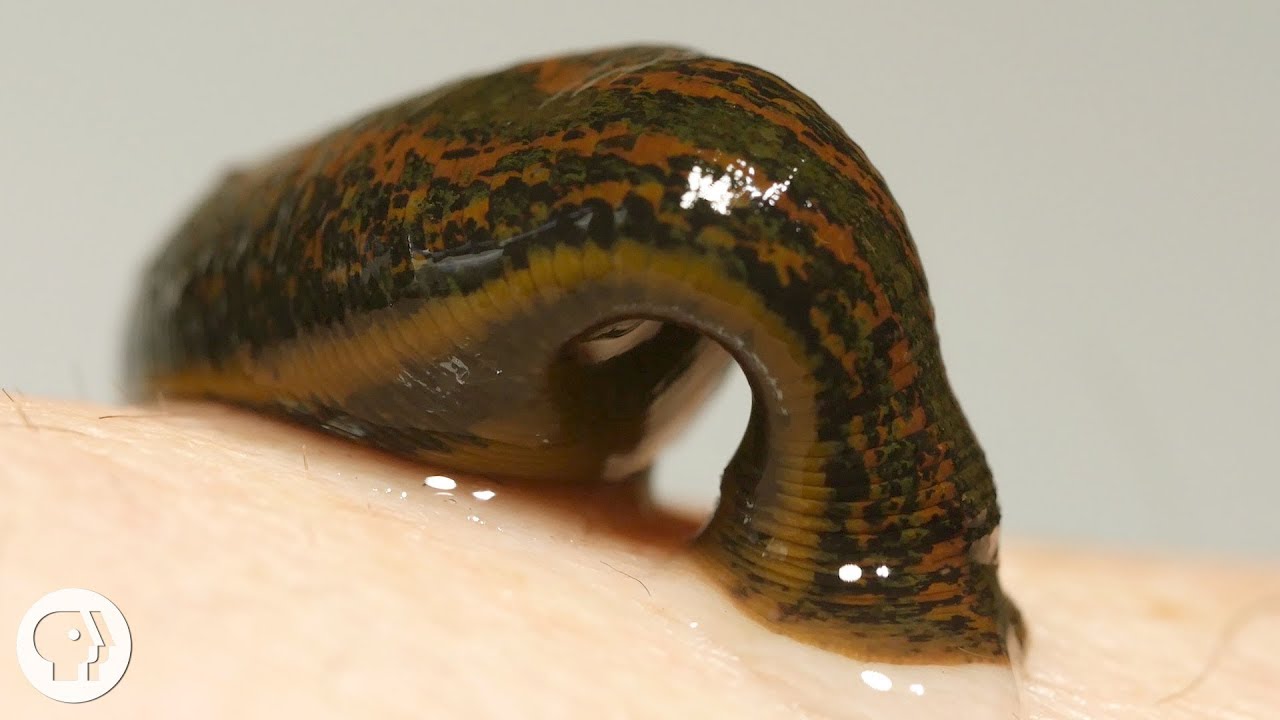
| Support Deep Look on Patreon!! https://www.patreon.com/deeplook (FYI - This episode is a bit more bloody that usual – especially a little after the 2-minute mark. Just letting you know in case flesh wounds aren’t your thing) The same blood-sucking leeches feared by hikers and swimmers are making a comeback… in hospitals. Once used for questionable treatments, leeches now help doctors complete complex surgeries to reattach severed body parts. SUBSCRIBE to Deep Look! http://goo.gl/8NwXqt DEEP LOOK: a new ultra-HD (4K) short video series created by KQED San Francisco and presented by PBS Digital Studios. See the unseen at the very edge of our visible world. Explore big scientific mysteries by going incredibly small. Leeches get a bad rap—but they might not deserve it. Yes, they’re creepy crawly blood-suckers. And they can instill an almost primal sense of disgust and revulsion. Humphrey Bogart’s character in the 1951 film The African Queen even went so far as to call them “filthy little devils.” But the humble leech is making a comeback. Contrary to the typical, derogatory definition of a human “leech,” this critter is increasingly playing a key role as a sidekick for scientists and doctors, simply by being its bloodthirsty self. Distant cousins of the earthworm, most leech species are parasites that feed on the blood of animals and humans alike. They are often found in freshwater and navigate either by swimming or by inching themselves along, using two suckers—one at each end of their body—to anchor themselves. Upon reaching an unsuspecting host, a leech will surreptitiously attach itself and begin to feed. It uses a triangular set of three teeth to cut in, and secretes a suite of chemicals to thin the blood and numb the skin so its presence goes undetected. —+ Read the entire article on KQED Science: https://www.kqed.org/science/1921659/take-two-leeches-and-call-me-in-the-morning —+ For more information: David Weisblat at UC Berkeley studies leeches development and evolution https://mcb.berkeley.edu/labs/weisblat/research.html Biologists recently reported that leeches in that region can provide a valuable snapshot of which animals are present in a particular area https://www.tandfonline.com/doi/abs/10.1080/14772000.2018.1433729?journalCode=tsab20& —+ More Great Deep Look episodes: Why the Male Black Widow is a Real Home Wrecker |
Deep Look https://www.youtube.com/watch?v=NpJNeGqExrc For Pacific Mole Crabs It’s Dig or Die |
Deep Look https://www.youtube.com/watch?v=tfoYD8pAsMw Praying Mantis Love is Waaay Weirder Than You Think |
Deep Look https://www.youtube.com/watch?v=NHf47gI8w04&t=83s —+ See some great videos and documentaries from the PBS Digital Studios! Above the Noise: Cow Burps Are Warming the Planet |
Reactions https://www.youtube.com/watch?v=MnRFUSGz_ZM What a Dinosaur Looks Like Under a Microscope |
Eons https://www.youtube.com/watch?v=4rvgiDXc12k Hawking Radiation |
Space Time https://www.youtube.com/watch?v=qPKj0YnKANw —+ Follow KQED Science: KQED Science: http://www.kqed.org/science Tumblr: http://kqedscience.tumblr.com Twitter: https://www.twitter.com/kqedscience —+ About KQED KQED, an NPR and PBS affiliate in San Francisco, CA, serves Northern California and beyond with a public-supported alternative to commercial TV, Radio and web media. Funding for Deep Look is provided in part by PBS Digital Studios. Deep Look is a project of KQED Science, which is supported by the S. D. Bechtel, Jr. Foundation, the Dirk and Charlene Kabcenell Foundation, the Vadasz Family Foundation, the Gordon and Betty Moore Foundation, the Fuhs Family Foundation Fund and the members of KQED. #deeplook |
SciencePBS4K







![[ENG SUB]《一往无前的蓝》完整版第4期:六选三?消防新生争夺出警资格 | First In Last Out](https://ytimg.googleusercontent.com/vi/6lJezggxFZ8/mqdefault.jpg)
![Mildew Riddim Mix [Mavado, Popcaan, Alkaline & More] April 2015](https://ytimg.googleusercontent.com/vi/tthzORU5xgU/mqdefault.jpg)