Presentation by Vida Mingo (Columbia College) at #Dros21. Learn more about the conference: https://genetics-gsa.org/drosophila/
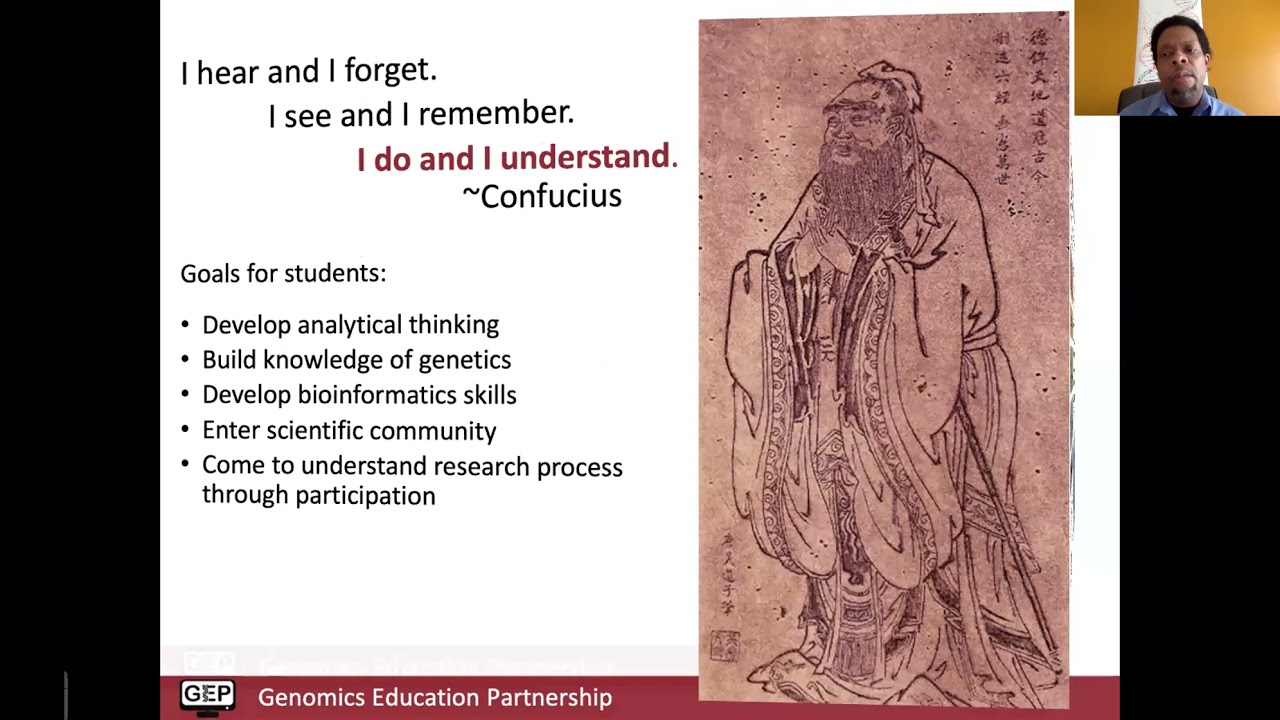
The Genomics Education Partnership (GEP; thegep.org) is a nationwide collaboration of faculty from 100+ institutions which aims to integrate Course-based Undergraduate Research Experiences (CUREs) centered in genomics and bioinformatics into the curriculum.
Participating institutions include community colleges, PUIs, MSIs, HBCUs, and R1 universities. The GEP web-based platform includes curriculum/training materials that can easily be incorporated into existing courses. For many faculty and their students, the accessible and immersive curriculum and custom bioinformatics tools provided by the GEP enable a unique opportunity to participate in research, even during the COVID-19 pandemic. GEP faculty benefit from a national network of like-minded colleagues and professional development opportunities. With NSF and NIH support, GEP is actively recruiting additional faculty members to use the GEP curriculum in their classrooms, particularly at MSIs and community colleges, and both science and science education partners to collaborate on additional projects. Over 1,300 students per year learn to annotate newly-sequenced eukaryotic genomes, creating defendable gene models. Students leverage evidence from related informant species, experimental data (e.g., RNA-Seq), automated gene prediction algorithms, evolutionary conservation, and basic molecular biology rules to develop their models. GEP partnered with Galaxy to develop G-OnRamp, an open-source platform for constructing UCSC Assembly Hubs and JBrowse/Apollo genome browsers, enabling more varied research projects, including our investigation of venom evolution in parasitoid wasps. Other GEP projects investigate the evolution of insulin pathway genes across 27 Drosophila genomes, and expansion of the F element in four Drosophila species. Student gene models are reconciled and collated to generate a large dataset for evolutionary genomic studies, with student/faculty co-authors; GEP is also piloting student publication of gene models as microPublications. We find that a bioinformatics CURE fosters experiences of “formative frustration” in which students can safely fail in their original analysis, adjust, recover, and succeed. This iterative process allows deeper insight into annotation and can occur fairly quickly within our inexpensive, online framework. GEP students show significant gains in scientific knowledge and attitudes toward science. Supported by NSF grants 1915544 and 1431407, and NIH R25GM130517.
GenomicsEducationPartnership,