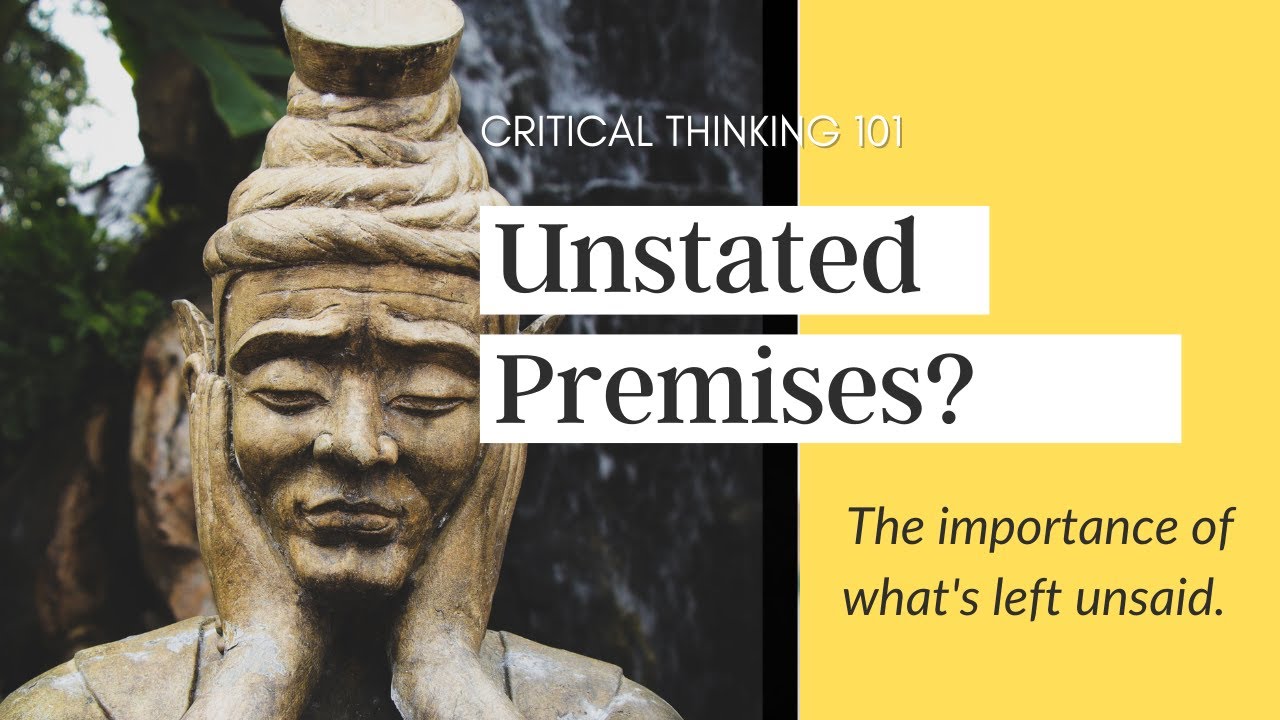
While we think it’s obvious what unstated premises we leave out of our arguments, it’s very important that we explicitly state them. The way you state your premises can determine the quality of your argument and whether you’re presenting a deductive or inductive one.
In the lecture below, we’ll practice determining what unstated premises would make an argument deductive vs. inductive.
**CORRECTION: At the 14:16 mark in the video, there is a typo in the unstated premise written on the screen. What I verbally say on the video is correct for Exercise 2-11 #5, but the text "…is a liberal" should read "…is NOT a liberal" on your screen.
More critical thinking videos? Check out the playlist - https://bit.ly/CriticalThinking_ProfG
—SUPPORT THIS CHANNEL—
+ Donate - https://www.patreon.com/ProfG
+ Subscribe - http://bit.ly/ProfG_YouTube
—COURSE TEXTBOOKS—
+ Critical Thinking - https://amzn.to/3aQY8nQ
+ Venturing into Philosophy - http://amzn.to/3nPnJSA
—MORE COURSE VIDEOS—
+ Critical Thinking Playlist - https://bit.ly/CriticalThinking_ProfG
+ Intro to Philosophy Playlist - https://bit.ly/Philosophy_Intro
+ Creative Thinking Playlist - https://bit.ly/Creativity_ProfG
+ Comparative Religion Playlist - http://bit.ly/ComparativeReligion_ProfG
—Prof G Books—
+ Taste of Transcendence - http://amzn.to/3im5BOV
+ Authentic Happiness in Seven Emails - http://amzn.to/3oRrRCF
+ The Power of Thinking Differently - http://amzn.to/2N8F8sB
+ The Happiness Habit (ebook) - http://goo.gl/Yb73XS
—For Speaking Engagements—
+ http://goo.gl/N5SeKR
—Follow Prof G—
http://www.javygalindo.com
http://www.facebook.com/javywg
http://www.twitter.com/jwgthink
What'sUnstatedPremise